

The Example of Socrates


The Example of Socrates
Europe’s First Coach
In the years running up to 400BC, Socrates would spend much of his time in Athens’s bustling marketplace, the Agora, asking people probing question about what living well means and listening attentively to their replies.
He didn’t play the role of the expert. He’d say, “I know that I know nothing.”
His method, rather, was one of guiding people in their own inquiries. He wanted them to apply their personal capacity for insight to the question of what makes for a good life. “The unexamined life,” he believed, “is not worth living.”
The Backlash
Youngsters, like Plato, loved that Socrates didn’t play the role of the expert; that he didn’t dispense advice; that, instead, he forced people to think on their feet. It was quite right, they believed, to question everything.
The city bigwigs didn’t agree. They didn’t want original thinking; they wanted respect. So they had Socrates arrested, tried and found guilty of corrupting the youth and of failing to acknowledge the gods that the city acknowledged.
Socrates had already turned 70. He’d lived a full life. He was sentenced to death by drinking hemlock and he willingly accepted his fate.
The Legacy
Plato, who’d learnt so much from Socrates, became one of the most influential and widely read thinkers of ancient times and Plato’s pupil, Aristotle, was more influential still. The Encyclopaedia Britannica said that “Until the end of the 17th century, Western culture was Aristotelian.”1
Socrates’s example was dynamite. He inspired multiple explosions — renaissances, enlightenments, and numerous individual rediscoveries of the power of original thought.
Today’s Coaching
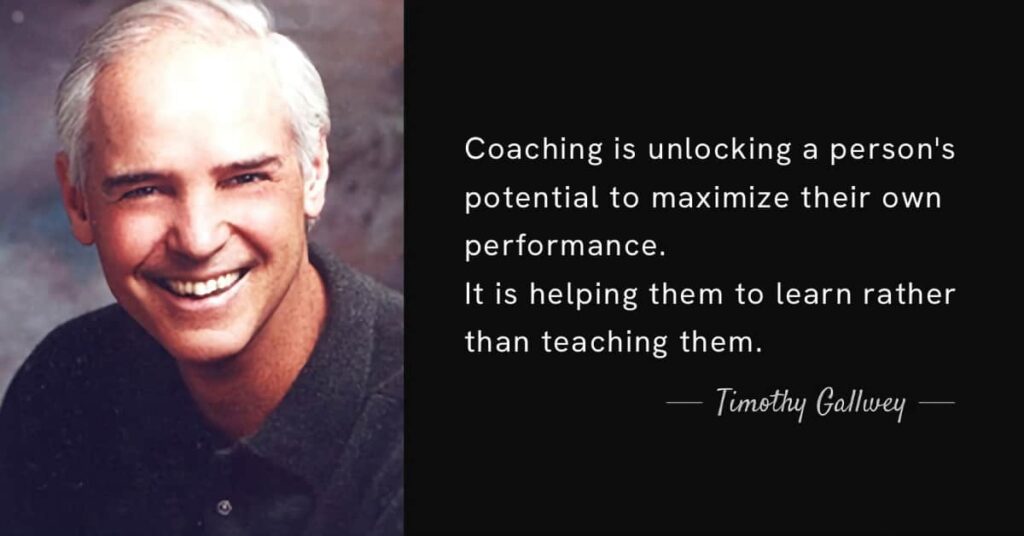
Coaching is a recent detonation that began bursting into being with Timothy Gallwey’s experiments in tennis coaching in the 1970s. Gallwey held back from telling people how to play better and instead devised techniques for them to discover and learn for themselves. Awareness was the key. Gallwey wrote, “Simply stated, the first principle of the Inner Game approach to learning is that whatever increases the quality of awareness in an individual also increases the quality of learning, performance and enjoyment. Conversely, whatever interferes with or distorts awareness of things as they are detracts from learning, performance and enjoyment.”2
As coaching spread from tennis court and golf course to the workplace, it kept its emphasis on awareness — on original seeing. Socrates’s example became ever more pronounced. Coaches would guide people to have insights into their own lives — into what matters and into what they can accomplish with their actions.
A Focus on Living Well
Much of today’s coaching helps people sort through the chaos of ideas and aspirations at the back of their minds to build a clarity of intent, or helps people achieve their goals by forcing them to identify the necessary steps and then holding them accountable.
Socrates’s favourite theme of what it means to live well is never far beneath the surface of a good piece of coaching. But rather than searching for universal truths, coaching looks for specific answers. How can a particular coachee best handle the dilemmas and challenges in front of them? What outcome would they most value and why? What courses of action could they take? What will they do?
Ultimately, coaching’s impact is exactly what Socrates would have wanted it to be. It helps people live examined lives.
References
- The New Encyclopaedia Britannica, 15th Edition, 2002, vol. 14, p. 55.
- W. Timothy Gallwey, The Inner Game Of Golf, London: Pan Books Ltd. 1986, p. 75.




Responses